

Product Overview
The Osprey DAQ-32-250-24 is a highly scalable data acquisition system designed for facility-wide synchronous sampling. By utilizing a GPS receiver and fiber timing network, the system synchronizes all distributed nodes to provide time-stamped data for configurations scaling up to 1,024 signals at 250 kHz. The infrastructure supports event-based and on-demand acquisition, and high-speed machine protection. At the node level, each 2U rack-mount chassis provides 32-channels of 24-bit resolution analog digitization. Serving as a high-density I/O front end, the chassis integrates seamlessly into the broader timing network to ensure reliable, precision data collection across the entire facility.
Product Overview
The chassis utilizes an LBL Marble FPGA carrier with dual 16-channel ADC FMCs, providing 32 different inputs with configurable AC/DC coupling. High-bandwidth fiber and Ethernet channels support deterministic data streaming, while firmware enables phase-aligned sampling across all nodes. Fully integrated with EPICS, the system provides seamless global clocking and remote management.
Key Features
- Precision: Continuous 24-bit, 250kHz data collection
- Scale: Deterministic synchronization and streaming for up to 1,024 signals
- Safety: 250kHz fast detection and mitigation for machine protection
- Workflow: Full signal-to-export data chain
- Integration: Built-in data viewer, HDF5 export, and native EPICS support
Proven Reliability
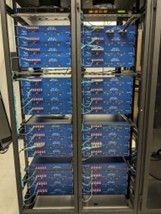
Successfully deployed at the NASA SEC facility to provide data acquisition for the Artemis capsule testing program.
Basic Architecture
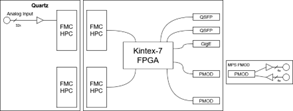
The Osprey Quartz ADC board contains four Analog Devices AD7768 ADCs around which the rest of the board is built. Inputs at the DB-37 connectors are scaled and pass through filtering and a per-channel selectable DC blocking stage before being sent to an ADC. The ADC then streams its data via LVDS through the FMC connectors to the Marble board.
The Marble board is built around a Kintex 160T 7 Series FPGA. This is one of the highest performing FPGAs available from AMD while allowing use of the license-free tool chain. The Marble board is responsible for monitoring, packaging, reporting, and synchronizing all events and triggers from various nodes.
The Osprey DAQ system is a distributed star network. A central GPS receiver and fiber timing network provide unified clock reference.
System Capabilities
- High-Bandwidth Streaming: Supports up to 1,024 signals at 250kHz streaming directly to disk
- Data Collection Modes: Features Sentry Mode (event-triggered) and Monitor Mode (on-demand) acquisition
- Data Management: Dedicated DAQ application for acquired data viewing and export to HDF5 format
Chassis Overview
Front Panel

- Dimensions: 19” x 3.48” (2U Rack Mount)
- Inputs: 2x DB-37F connectors, 1x BNC TTL (PPS)
- Interface: 8x LC fiber connectors (EVR In, EVF In, 6x EVF Out)
- Power Status LED; Dual handles
Back Panel
- Dimensions: 16.8” x 3”
- Interface: 2x DB-9, Ethernet
- Power: DC connector, 5A fuse
Internal Architecture
- Carrier: Marble FPGA
- Expansion: Osprey Quartz ADC Board
- Thermal Management: Side-mounted (outlet) and rear-mounted (inlet) fans
Tech Specs
Nominal Performance
- Analog Inputs: 32 channels, 24-bit resolution per chassis
- Sampling Rate: Up to 250kHz
- Analog Input Impedance:999kΩ - 1MΩ
- Analog Input Range: ±10V
- Analog Bandwidth: 100kHz @ 250ksps, 20kHz @ 50ksps, 10kHz @ 20ksps, 5kHz @ 10ksps, 2kHz @ 5ksps, 400Hz @ 1ksps
- Channel Cross-Talk: -94dB
- Gain Accuracy: 0.13%
- Pass-band Ripple: 0.1dB
- Effective Resolution: 19b @ 250ksps
- Coupling: User-selectable AC or DC
- Clock Stability: Shared common sampling clock across chassis
- Digital I/O: 4 DI and 4 DO with limit checking
- Timing: 1 Event Receiver and 7 Timing Fanouts
Absolute Performance
- Ambient Temperature: 32 channels, 24-bit resolution per chassis
- Ambient Humidity: 90% non-condensing max
- Power Input Voltage: 0V DC - 13V DC
- Power Current: 4A
- Analog Input Abs. Voltage: ±15V (DC coupled), ±25V (AC coupled)
- Analog Input Diff. Voltage: ±30V
- Pulse-per-Second Input Voltage: -0.7V - 5.5V
Other Specs
- EPICS Integration: Configuration, control and monitoring of the DAQ infrastructure
- Real-Time Analytics: Time-series data and FFT spectrum to clients at 20Hz
- System Health: Integrated “State of Health” monitoring for every channel and chassis node
- Data Export: Application supports data viewing and export to HDF5 format
- Open source project repos
- github.com/osprey-dcs/quartz-daq-250-24
- github.com/BerkeleyLab/Marble